Keys Hidden in the Swords
The Portable DoorThe Keys Hidden in the Swords turn the familiar promise of a sword in a stone into a practical mechanism: the blades conceal two keys needed to open the portable door. Their discovery links a fairy-tale-style test to the door’s literal locks, while leaving open who arranged the keys and why.
A Royal Inscription and a Hidden Use
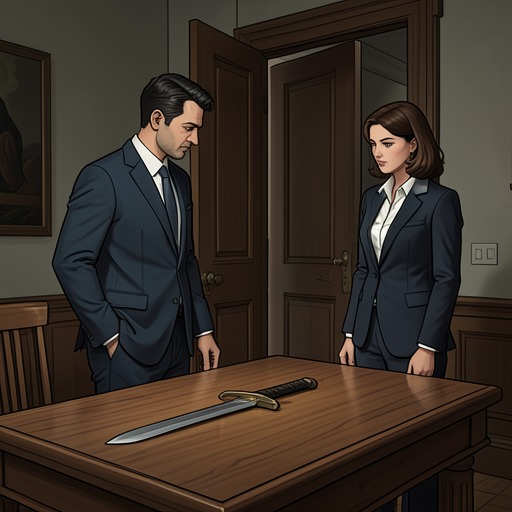
The stone bears tiny lettering, so small that Paul Carpenter has to kneel and squint to read it. Its main inscription declares, “Whoso draweth this sword from this stone shall be rightful king of all England.” Beneath it, in even smaller letters, is the instruction to dispose of the stone tidily after use. The grand promise and the throwaway practical note make the stone both a legendary challenge and an oddly mundane object. The swords’ concealed purpose is less grand than the inscription suggests. When Paul and Sophie Pettingell finally draw one, its tip proves blunt and crinkled rather than sharp: it has the shape of a key’s wards. The apparent weapon is a disguise for a functional piece of metal, and the royal test leads instead to the means of opening a magical door.
The Test and the First Key
Before the discovery, Mr Tanner’s mum warns that the portable door has two keyholes and therefore must require two keys. She expects neither to be an ordinary brass key: based on Humphrey Wells’s habit of putting spells and tests on everyday devices, she anticipates a disguise or an obstacle to retrieving or using them. Paul seizes on her mention of a test and recognizes the pattern as something out of a fairy tale. At the first stone, Paul takes one side of the crossguard and calls Sophie over to hold the other. They pull together; the sword comes free so smoothly that they nearly fall over. Paul examines the key-shaped tip, grips the key portion, and bends it sideways. The metal is brittle and snaps off. He pockets the key, returns the sword to the stone, and reattaches the washing line that had been connected to it. The extraction leaves the blade in place but separates its hidden function for use elsewhere.
The Pair Opens the Door
With enough expense money for a taxi, the group travels from Wimbledon to Kentish Town. The second sword, at Paul’s flat, comes out as easily as the first, and its key breaks off like the tip of an icicle. The two recoveries establish that the first key was only half the solution: the portable door has matching upper and lower locks. Paul takes the door from its cardboard tube, smooths it out, and plasters it against a wall. He tests the first key in the top lock, then its counterpart in the bottom; both fit perfectly. The keys are therefore not merely clues or curiosities but a matched pair whose shape and placement correspond to the door’s two-lock mechanism.
Unresolved Origin
Once the locks accept the keys, Paul says he does not think Humphrey Wells put them there, and Sophie asks who did. The moment turns successful retrieval into a new question: the keys solve the immediate problem of access, but their maker and purpose remain uncertain. Their concealment also recasts the swords. What first appeared to be a test of royal destiny proves to be part of a more immediate puzzle involving the portable door, and the solution depends on recognizing the fairy-tale form without taking its promise of kingship at face value.